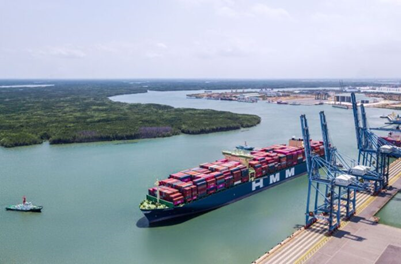
THOOTHUKUDI: V O Chidambaranar Port Authority, the State-owned entity that runs the port at Thoothukudi in Tamil Nadu, has mandated the Indian Institute of Technology Madras (IIT Madras) to build two artificial intelligence/machine learning-based functionalities – prediction and anomaly detection – to enhance ease of doing business and operational efficiency through data science and related technologies at the port.
This is the first-of-its-kind initiative taken by a port in India, emphasising the importance technology will play in boosting productivity and efficiency.
The proposed functionalities will be applied to two phases of the port’s operations – in the sea and on land – captured through the metrics of vessel turnaround time (VTT) and dwell time (DT). Both modules will use a wide range of input features, such as cargo type, volume, vessel parameters, berth parameters, cranes allocated, truck gate protocols, truck assignment, etc.
The turnaround time of a ship (VTT) refers to the time the vessel reports at the anchorage of a port to the time it sails out from the berth after unloading/loading cargo while cargo and container-related dwell time (DT) refers to the time cargo and containers stays in a terminal’s in-transit storage area while awaiting shipment by vessels in the case of exports or evacuation by rail or road for imports. The two broadly reflect the efficiency of a port.
At V O C Port, a container ship is turned around in 20 hours, on average.
One of the major delays that occur during the entire journey of a ship is during its scheduling at a port. A ship might have to wait for the docks to be vacant to unload/load its cargo or it might wait for a tug and pilot to bring them in, which are referred to as pre-berthing delays.
Even after berthing, the availability of manpower, machinery and appropriate permissions/ protocols for cargo handling play a critical role in minimizing VTT.
From a port’s perspective, a high dwell time locks up resources – manpower, machinery, storage, etc. This increases the cost of doing business, which translates into lower profitability if the cost is absorbed, or it makes the port a less attractive channel if the cost is passed on to the customers.
In Indian ports, the land-based distribution goes through multiple workflows. For instance, some cargo is processed through the yard and container freight station (CFS) prior to exiting the port, while some others are evacuated by direct port delivery (DPD) which helps move the container directly from the terminal to the cargo owner.