

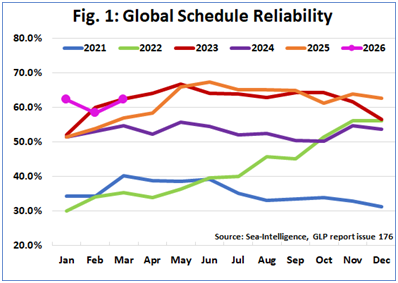
Oslo - In March 2026, global industry schedule reliability increased by 3.9 percentage points M/M to 62.2%, making this the joint-highest figure for 2026. On a Y/Y level, schedule reliability was higher by 5.2 percentage points. With improving schedule reliability, the average delay for LATE vessel arrivals also improved, decreasing M/M by -0.14 days to 5.48 days. Despite this, on a Y/Y level, the March 2026 figure was 0.36 days higher.
Hapag-Lloyd was the most reliable top-13 carrier in March 2026 with schedule reliability of 72.3%, followed by Maersk with 70.8%. Eight carriers had reliability in the 60-70% range, while two were in the 50-60% range, and Wan Hai was the least reliable carrier with schedule reliability of 46.6%. Only two carriers recorded an M/M decline in schedule reliability, while 11 of the 13 carriers recorded a Y/Y improvement.
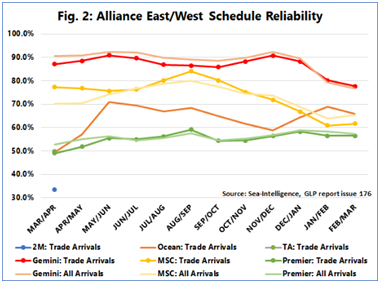
In February/March 2026, Gemini Cooperation recorded 76.8% schedule reliability across ALL arrivals and 77.6% across TRADE arrivals, followed by MSC at 65.4% for ALL arrivals and 61.6% for TRADE arrivals. Premier Alliance recorded 57.2% for ALL arrivals and 56.5% across TRADE arrivals. For the "old" alliances, "ALL arrivals" remain equal to "TRADE arrivals," and Ocean Alliance scored 65.9%.
Traditionally, alliance scores are based on just the arrivals in destination regions, but as that metric was not available for the new alliances in February 2025, we introduced a new measure, based on all arrivals, including the origin region calls on the East/West trades. We continue to present both measures, “All arrivals” which is comparable to the February measure, and “Trade arrivals”, which is comparable to the “old” alliances.
Disclaimer: This information has been collected through secondary research and Daily Shipping Times is not responsible for any errors in the same.


You cannot copy content of this page