


Copenhagen - Sea-Intelligence analysed the capacity deployment trends in the 10 weeks leading up to Chinese New Year (CNY) 2026. By indexing deployed capacity against a stabilised pre-peak baseline, we identified a significant deviation from historical norms. The data indicates that shippers have adopted a "front-loading" strategy on the Asia-North Europe trade, likely to mitigate the impact of extended transit times.
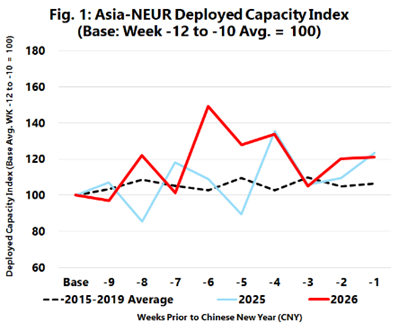
Figure 1 : Illustrates the magnitude of this shift. Historically (2015-2019), the pre-CNY capacity ramp-up on Asia-North Europe was moderate, with capacity growing approximately 10% from the baseline to the peak. In contrast, the 2026 projection shows a surge in intensity that essentially quadruples the historical data.
From a 2026 baseline of 282,947 TEU, deployed capacity ascends to a peak of 421,825 TEU by Week -6 (six weeks prior to CNY). This represents a net injection of 138,878 TEU, or a 49.1% increase above the baseline. Even when adjusting for potential vessel delays, the capacity index remains significantly elevated above index 130 through Week -4.
This suggests a structural adaptation to the current network dynamics. With extended transit times around Africa, shippers are pushing massive volumes into the European network much earlier than usual – peaking six weeks before the holiday – to ensure inventory is buffered before the post-CNY capacity withdrawal. This front-loading strategy is mirrored on the Asia-Mediterranean trade, which exhibits the highest relative growth of all trade lanes, surging 62% in just five weeks to reach a peak of 278,172 TEU. The Transpacific trades, however, display different volatility profiles. Asia-North America West Coast is characterized by extreme instability and a risky late-season spike, while Asia-North America East Coast maintains a sustained high-capacity floor, holding volumes 25% above the baseline right up to the start of CNY.
Disclaimer: This information has been collected through secondary research and Daily Shipping Times is not responsible for any errors in the same.


You cannot copy content of this page