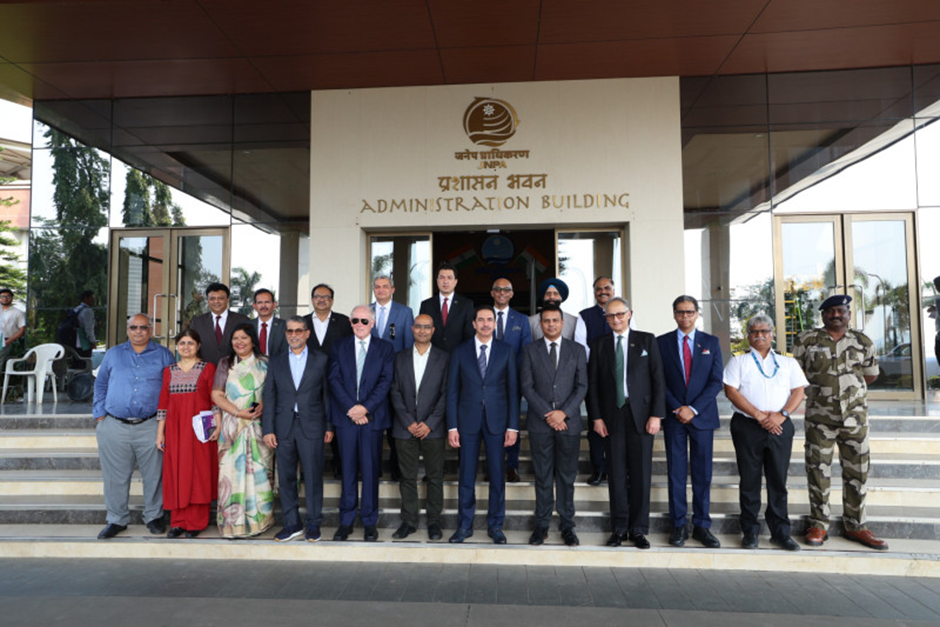


Navi Mumbai - JNPA, India’s busiest public container gateway, has announced it is in a position to handle double-stacked container freight trains out of its new integrated rail yard for all terminals in the harbour.
The port has five container terminals and mixed or combined train operations have been its mainstay for inland container depot (ICD) volumes.
The state-of-the-art integrated rail yard, designed to handle double-stacked container trains, is set to commence on the Dedicated Freight Corridor (DFC) rail lines for all the five terminals, informed a recent communique from JNPA recently.
The authority went on to say, “This advanced common rail yard will streamline operations and enhance efficiency at the port.”
The sophisticated integrated common rail yard has been developed in an effort to upgrade the port’s infrastructure for seamless freight movement as demand builds, propelled by the DFC connectivity.
According to a previous port statement, the long-haul common yard has three lines of 1,500 metres for double-stack container trains, out of which two are top-wired ballastless lines meant for loading and unloading of containers, and one is for engine turnaround of electric locomotives.
The Western DFC project, a high-stakes investment for India’s containerised trade, is a 1,504-kilometre broad-gauge freight only connector between Dadri, the busiest ICD in North India, and Nhava Sheva.
Along the DFC route, it is estimated that advanced wagons can carry freight up to 81 tons per wagon at a speed of 100 kilometres per hour, including for double-stacked container trains, compared with 60 kmph on the normal network.
JNPT has been working hard to convert more truckloads to the rail mode to alleviate road congestion and improve container dwell times.


You cannot copy content of this page